Which model is right for an acoustic band looking to single-mic?

single mics - louise josephine myrtle

Are you a 3+ person band wanting to single mic your vocals and acoustic instruments?

Check out MYRTLE, DELPHINA, Louise, OR Josephine.

These models are best suited to single-miking an acoustic or bluegrass band. They all have much better feedback control than the studio large diaphragms commonly used for this purpose – we think you’ll find them much easier to use.

Myrtle, Louise, Josephine, and Delphina have more low-end extension than our signature Edwina model, which helps with keeping the sound full when you’re a little farther from the mic as you need to be with more players. In terms of the differences between these models, Myrtle and Delphina (acoustically identical to one another) have much of the tone of Edwina, since it’s the same head basket. The other ring models (Louise, Josephine, the bicycle gear models) have a slightly different sound, but are acoustically identical to one another – a little bit more high end detail, a little fuller low end.

As for how to make the most of them, you should be able to get at least a bit of monitor, better than any other available large diaphragm mic, but how much really depends on the acoustics of the room/stage. Watch out for things like big windows right behind you (common in bars and coffee houses). The more you can do to damp the reflections behind and above you the better you’ll be. There are practical limits to getting sufficient gain to pick up an instrument at 4 feet from the mic if there’s a reflective wall at 6 feet. In tough acoustic spaces like that it really pays to work on playing as close to each other and the mic as you can. Plus, it’s fun to play that way! For more info about single miking, take a look at our FAQ “What’s the deal with single micing?

Take a listen: Fantastic Wood & Wire album recorded entirely with one Myrtle


Are you a duo wanting to share a mic?
Check out Edwina, DELPHINA, or Myrtle.

For a duo wanting to share a mic, I’d suggest a Myrtle, Delphina, or an Edwina depending on how close you want to work the mic. They have similar sound, and great feedback rejection for live use; Myrtle and Delphina have less low end roll off than Edwina, which I think may help with a full sound from guitar if you’re not working terribly close to the mic. There are duets (like the Milk Carton Kids) that use the Edwina and sound great, but you want to be practiced at working together so you can keep your instrument within about 18 inches.

Still have questions?

Feel free to email us questions about your specific application and we can make a tailored recommendation for which mic will work best for you.

Which model is right for me as a guitarist?

guitar microphones - edna edwina

Guitarists and other acoustic instrumentalists should check out Edna or Edwina.

Edna and Edwina are both excellent guitar mics. Edna is a lovely acoustic instrument mic; as a small diaphragm mic she’s a bit drier than Edwina. Some guitarists favor one, some the other. An advantage of having two Edwinas is the flexibility that gives you – if you ever play with anyone else you’ll have a great duet setup, and they’ll make a fine stereo pair for recording.

If you need a fill mic on guitar to use with a single mic set-up, I would suggest Edwina for that role. She sounds wonderful on those instruments and is still a nice sensitive mic that will give a very natural sound if you just position her so your instruments are within a foot or 18 inches.

STILL HAVE QUESTIONS?

Feel free to email us questions about your specific application and we can make a tailored recommendation for which mic will work best for you.

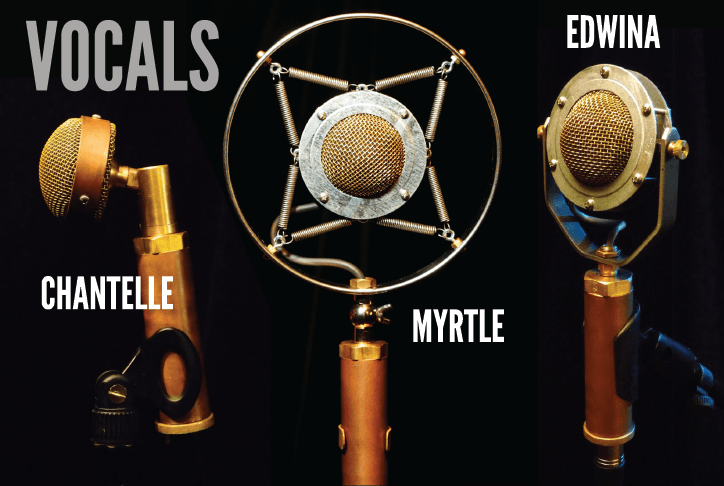
Which model is right for me as a vocalist?

vocal mics - chantelle myrtle edwina

Check out Edwina, Chantelle, or Myrtle.

For vocals many people choose an Edwina. If you watch the video below you’ll see how versatile she is and hear how warmly and naturally she reproduces a wide variety of vocals. Though tuned for closer use than our suspended ring models, Edwina can still be worked from much farther away than most live vocals mics, remaining full-sounding from very close up out to around 18 inches away.

Edwina and Chantelle do not sound radically different; Chantelle has a little more upper mid lift and possibly an even smoother high end. Chantelle has more internal padding, which mainly means she hits the pre a little differently. They are different flavors, but subtly so. Myrtle is basically an Edwina in a spring suspension mount with less low-end roll off(which makes it better for working from a distance). Sonically they are very similar except for the ability to work the Myrtle from farther away.

Still have questions?

Feel free to email us questions about your specific application and we can make a tailored recommendation for which mic will work best for you.

Which model is right for me as a recording engineer?

studio microphones - mabel evelyn

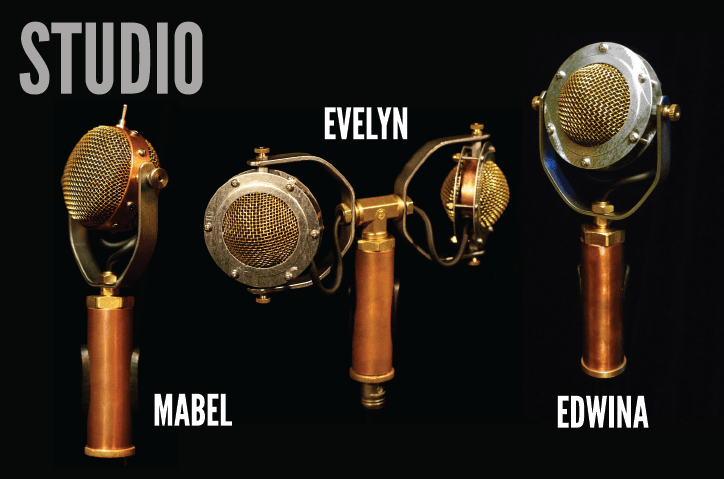
Recording engineers, check out Edwina, Mabel, or Evelyn.

Mabel is a multi-pattern studio condenser. Try her on her own or with an Edwina for a great sounding mid-side mic configuration.

Edwina is a versatile workhorse microphone that sounds fantastic in the studio and has the added bonus of being able to be used live onstage. She’s our signature model, and much beloved by her fans. A matched pair of Edwinas can go a long way in a studio— try them on vocals, acoustic instruments, guitar amps, and drum overheads.

Evelyn, our newest model, is a weirdo and very cool looking. She’s perfectly spaced for the ORTF stereo recording technique, with all the warmth and versatility that people love in the Edwina.

STILL HAVE QUESTIONS?

Feel free to email us questions about your specific application and we can make a tailored recommendation for which mic will work best for you.

I’m not in the U.S.— how can I buy one?

We have some wonderful international dealers— see our Resellers page for more info. You are welcome to purchase from any of our dealers, or directly from us as we ship internationally via our webshop. Keep in mind that we don’t collect Duty and VAT ourselves; those will be assessed by your local authority when the mic arrives and we do not include those charges in our price. If our website has any trouble calculating the best price on international shipping, please email us (sales@eartrumpetlabs.com) with the model(s) you are interested in, your preferred delivery address, and  your phone number so we can prepare you a shipping estimate and an invoice.

Which side of the mic is the front?

Good question. This is something that’s not necessarily intuitive when you first start working with your Ear Trumpet mic, and that’s okay! Once you figure it out you’ll feel like you’re in a secret club of great sounding performers.

edwina edna myrtle evelyn screw heads

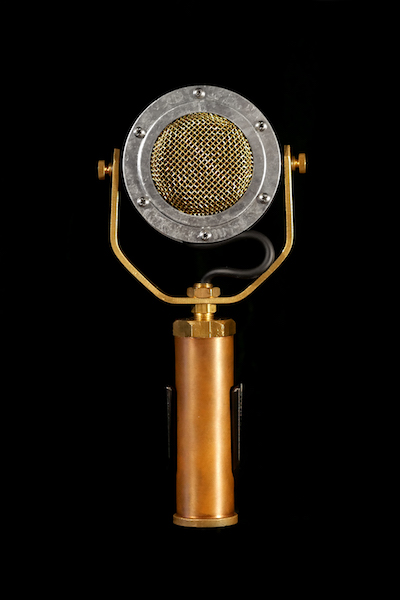
On the models with silver faceplates (Edwina, Edna, Myrtle, Delphina, and Evelyn) the silver screw heads are visible on the front of the microphone (faces the performer or sound source) and the brass nuts are on the back (faces the audience in a live setting).

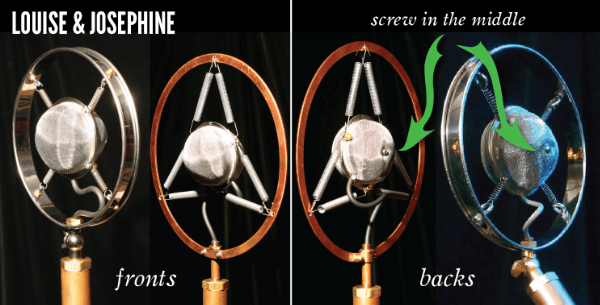
louise and josephine front and back

On the mics made out of tea balls (yes, those were originally intended for loose leaf tea), the front is the side without a screw in the middle of the ball, and the back is the side with the screw.

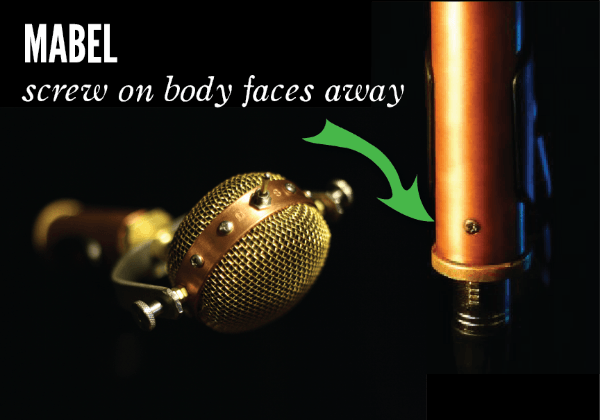
mabel microphone - screw on body faces away

The Mabel has perhaps to most subtle indicator of all— the screw on the copper body of the microphone indicates the back. The Omni indicator (O) on the top of the mic should be on the left-hand side, and the Figure-8 indicatior (8) should be on the right.

So if you’re rushing to set up for a show and something doesn’t sound quite right, or there’s a bit more feedback than normal— double check that the mic isn’t backwards. It happens to the best of us.

(We’ve had people tell us that ours was the best-sounding mic on stage— even backwards!)

Do they need Phantom Power?

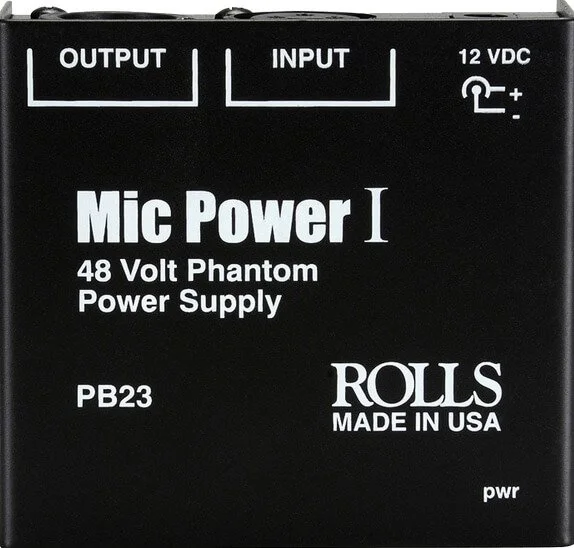
Yes. All condenser microphones need phantom power to operate. In situations with a PA or house sound it should be a non-issue since virtually all mixing boards provide phantom power. However, musicians toting their own combo amp or portable PA to small venues need to make sure they have phantom power for their mics. If your system doesn’t provide phantom power (most newer ones do) it means you will have to carry a small external phantom supply and one extra mic cable. Phantom power supplies are inexpensive and commonly available. They are simple devices and don’t affect tone, so any reasonably sturdy one should do just fine. Even if you don’t bring your own vocal PA, sometimes things break, or don’t work as advertised, so it’s usually a good idea to keep that phantom box in your gig bag just in case.

Our mics require at least 24V of phantom power. Less than that won’t hurt them, but they may perform erratically. We sell one we like from Rolls ourselves (see below) but any 24V or more phantom power adapter will do!

-

 
mic power 48 Volt Phantom Poser Supply

Rolls PB23 Phantom Power Adapter

Rolls single-channel 48 volt phantom power supply. We like the build quality of this model, and the fact that it's American-made like our mics.


Why use condenser mics for live performance?

 
Philip Graham headshot

by Philip Graham
owner/bricoleur of Ear Trumpet Labs

I spend a lot of time thinking and talking to people about why I’m building condenser microphones rather than dynamics. The short answer is, I like the sound better, and I think when designed right condensers can be as good for live use as any mic out there.

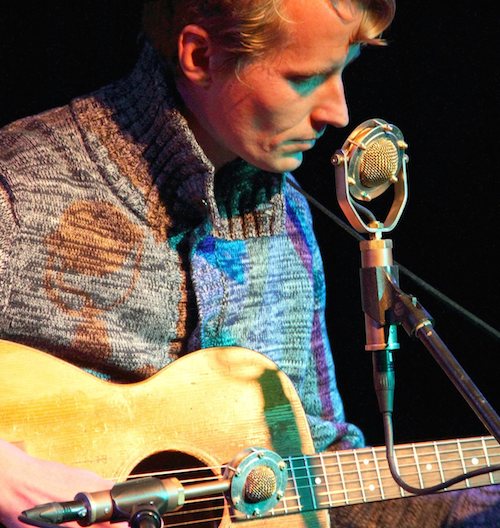
tom brousseau playing acoustic guitar with Edwina and Edna

Even though condenser mics are getting wider and wider use in live sound, there remains a common prejudice among many performers that dynamics are somehow inherently better for live use. Usually there’s a belief that dynamics resist feedback better and control bleed from other parts of the stage; coupled with an attitude that any differences in sound won’t matter through a PA. Well, differences between mics are very audible in live settings, especially with modern sound systems. I’ve heard a singer in a jazz club with a modest newer PA switch for one song from my Edwina to a standard 58 that was set up at the piano, and the change was unmistakeable – unmistakably worse. Would you really not care what amp you use for your guitar because it will “probably sound terrible through the PA anyway”?

As for feedback and bleed, it’s all a matter of what the specific microphone is designed for, and how well it is implemented. Both are entirely controlled by the frequency response and polar pattern (directionality) of the mic, and especially the polar pattern across the frequency response. Most people look at polar patterns at 1K, which is in the middle of the mic’s response; but for feedback control the microphone really has to have the same off-axis rejection all across its response range. However, the polar pattern is never the same at all frequencies (except for a ribbon mic’s figure-8 pattern). Almost always, the high frequencies have worse directional control – and it’s usually the high frequencies that are the most problematic for feedback. Taming the off-axis high frequency response can be done through acoustic adjustments to the capsule and careful design of the headbasket, as well as controlling overly-hot high frequencies in the overall EQ of the mic circuitry. I make all these adjustments in my mics, and they have gain-before-feedback that is directly comparable to common stage dynamics like a Shure 58 or an Audix OM5, even in tough acoustic environments.

The big advantage of condenser mics is their sound. A well-built condenser capsule is inherently more capable of a smoother response through the full frequency range than a dynamic. This is simply due to the physics of their construction. The moving part of a dynamic capsule, which is driven by the sound in the air being captured, must have much more mass than the diaphragm of a condenser capsule. It will be much more difficult to make it respond to high frequencies, and it will have severe resonant peaks and valleys at various frequencies. A good dynamic capsule is very carefully designed to add a whole series of these acoustic resonances together, which combine to give a fairly smooth response. But it’s still inherently more irregular and “peaky” than a condenser and less responsive at very high frequencies. Worse high-frequency response is the same as saying that it reproduces transients less accurately. There are certainly some fantastic-sounding dynamics out there – many of which are designed for the studio and are no more appropriate on stage than a U87. But at any rate, a dynamic capsule is a complex mechanism engineered to work in a specific microphone body and cannot very effectively be transplanted and modified, whereas I can control almost every aspect of the sound of my condenser mics.

All of this was brought home for me recently when Ear Trumpet Labs provided the microphones for the Portland Old Time Music Gathering. These were all-acoustic performances; these musicians care a lot about having the tone and quality of their instruments faithfully reproduced – they’d all much rather be completely unamplified, just playing in your living room. The Ear Trumpet mics were mostly used from a distance, usually with Josephine or Louise set up as a conventional bluegrass single mic, with Edwinas and Ednas available for spot micing instruments that needed it, or when the group was spread too far to the sides for the single mic to pick up everyone. Normally these performers are used to using a large-diaphragm condenser intended for studio use; they need the sensitivity and accuracy such a mic gives, but usually they can’t use stage monitors at all with such mics. The Ear Trumpet mics gave them the best of all worlds – the sensitivity to work from a distance, the accuracy to sound completely transparent, and the feedback rejection to be able to monitor. You really can have both great quality sound and the feedback rejection to make stage use easy – not to mention great looks!

Condensers mics need phantom power to operate— see this FAQ for more.


Shop Our Top Single Mics

Myrtle microphone on black background

MYRTLE

Louise microphone on black background

LOUISE

Delphina microphone on black background

DELPHINA


GOT QUESTIONS?

Feel free to get in touch!

503-974-4147
info@eartrumpetlabs.com

2117 NE Oregon St. #303
Portland, OR 97232